
Why families went back to Poilarocca in autumn
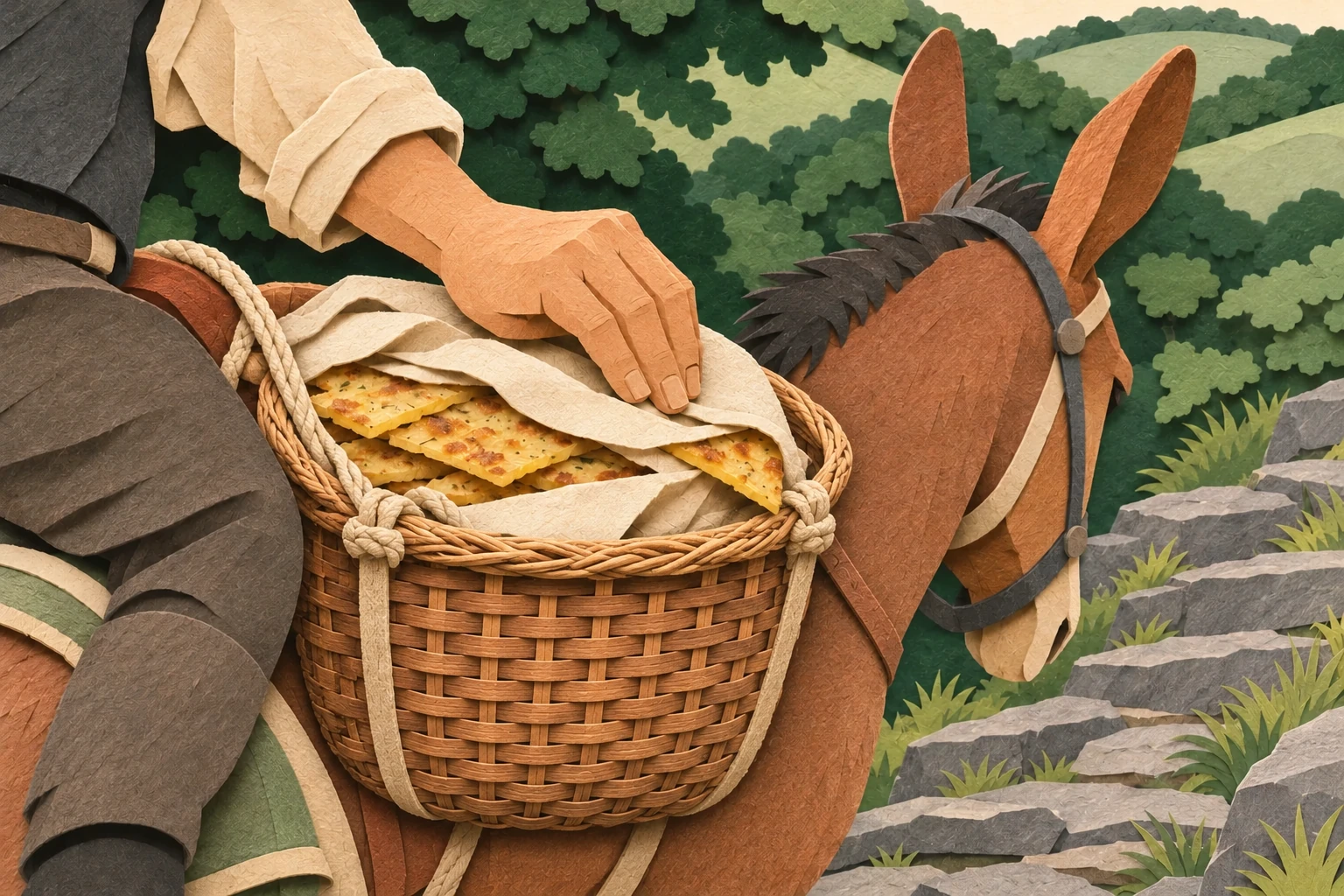
At the end of summer, families in the Ligurian Alps came home to Mendatica and left much of their harvest up at Poilarocca. Their stone houses there, in a hollow below Monte Frontè, kept the hay dry and the potatoes, grain and pulses under cover. There was too much work to do at the end of the season to carry it all down at once. In autumn, when the fields needed less attention, the families made the climb again.
That, people in Mendatica say, is why they went to the trouble of paving the mule track. Above the Arroscia waterfalls it climbs in tight bends known as e Scarette, the little steps. Long stretches were laid with stone slabs, others with cobbles. A family bringing a load down those bends needed a firm footing even after the autumn rains.
What Pinotta carried
A collection of stories from Mendatica, Il bianco della cenere, tells of nine-year-old Pietrino’s first trip to the Sciorta, a meadow below Monte Frontè. It was early August and the haymakers were nearly done. His mother had baked a potato pie so big the tin barely fitted in the oven. She cut it into pieces, wrapped them in a clean tablecloth and packed them in the baskets on their mule, Pinotta.
At the falls Pietrino ran ahead to see where the water disappeared. His father had to come and fetch him. Farther up, the family stopped to pray at the pilone, the little stone wayside shrine. It was on the steep stretch after that stop that Pietrino saw corners of pie working their way out of the basket. Without getting off the mule, his father punched them back in. When they unpacked lunch at the meadow, the pieces underneath had survived. There was still pie for the haymakers.
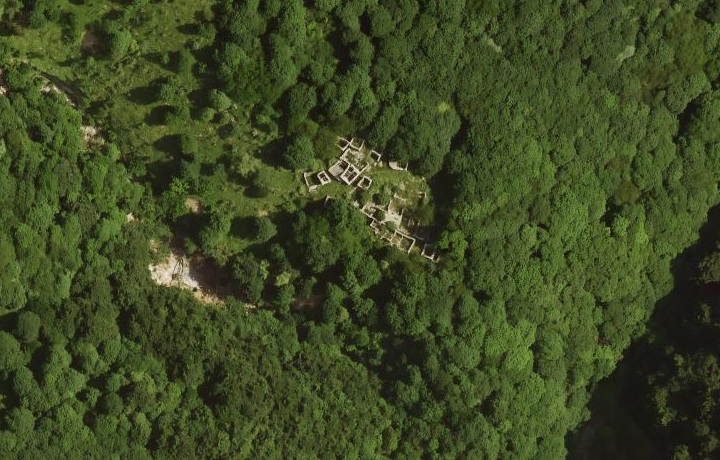
Beyond the shrine there was a good way to climb to the tecci, the stone houses where families stayed with their animals for the summer. The livestock occupied the ground floor. An outside stair led up to the family quarters and the hearth. In the 2022 aerial photograph you can still pick out the rooms, open to the sky where the meadow meets the woods.
Thirteen shares and a painted devil
The Ascheri family built Poilarocca’s chapel and dedicated it to the Madonna della Neve, Our Lady of the Snows. According to the village account kept by Mendatica’s Pro Loco association, ownership of the chapel was divided into thirteen shares, known as teste. Holding even one share entitled its owner to graze livestock on the settlement’s common pasture. Over time, some shares passed to other families.
What the children remembered was a devil with enormous fangs in the bottom right corner of the chapel painting. In a childhood recollection published by the Pro Loco, the storyteller says that after dusk none of the children dared go near the chapel. Corrado Agnese, who credits Giovanni Battista Sibilla and his son Fabrizio for their testimony, records a local saying. In Mendatica you could tell someone they were just like the devil in the chapel at Poilarocca.
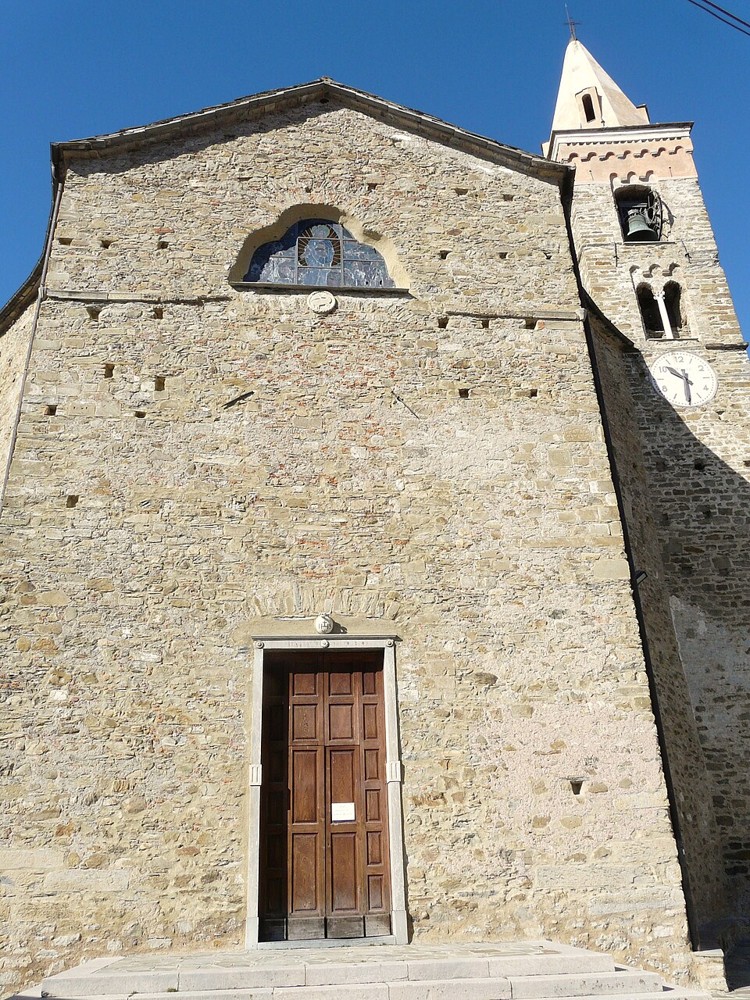
You can look for the painting down in Mendatica, at the parish church of Santi Nazario e Celso. It is Giacomo Rodi’s Madonna and Child with Saints, dated 1632. Agnese gives the day it was donated to the parish as 28 July 1953.
The pots at Cian de Lapasse
There is a story in Mendatica that the first houses of Poilarocca stood a little way from the ruins we see today. One winter in the early 1700s, an avalanche is said to have swept them away. The summer settlement was empty and the story recalls no deaths. What people remembered was how far the families had to go to look for their cooking pots, the lavezze and brunzin. They searched as far down as Cian de Lapasse, where the Rio Passo meets the Arroscia. In the version passed on by the Pro Loco, the families then rebuilt on more sheltered ground. The year of the avalanche and the site of the first houses remain uncertain.
The roofless houses have a more recent family history. When the journalist Laura Guglielmi wrote about visiting Poilarocca with the architect Giovanni Spalla, she put the end of its inhabited years at the Second World War. A reader, Tiziana Belli, wrote to tell her that her husband, born in 1951, had spent his childhood summers there. People still went up to patch the roofs with sheet metal and mend what they could of the chapel. Spalla had surveyed the houses with Caterina Arvigo. On his return he showed Guglielmi what he could still make out in the apse. The roof had fallen in, but the plasterwork and patches of blue and yellow were still visible.
Before you go
As of 23 November 2026, the park still lists the Arroscia waterfall circuit as temporarily closed. The mayor’s order of 18 June 2024 closed the trail to walkers. The region announced funding for repairs in January 2026. Check the park’s website for its reopening notice before planning the climb from Santa Margherita. For the condition of a particular stretch, call the park on +39 0183 753384.
Look for two separate landmarks on the map. The Pilone di Poilarocca (1,146 m) is the shrine above the waterfalls, by the fork for Case Pian del Lago. The ruins of Poilarocca (1,424 m) stand about 280 metres higher. For walkers coming up from the Gruppin bridge and Passu Serena, the right branch led to Case Pian del Lago and the left climbed to the summer houses. In 2008 the sign at the shrine still gave an hour to the houses. The park puts the full upper circuit, by way of Case Penna and back through San Bernardo, at about six hours.
There is also a winter restriction on the upper approach. Since 9 November 2026 the SP 2 from San Bernardo towards Colle del Garezzo has been closed to vehicles between km 0.5 and km 7 until further notice. Check the condition of the path with the park before attempting to approach the ruins on foot from above. If you stay in Mendatica, you can still go looking for the painted devil that kept Poilarocca’s children away from the chapel after dark.
Sources and visitor information
- Life in the summer settlement · Mendatica Pro Loco on autumn stores, shares and the avalanche story · Pietrino and the potato pie, pp. 51–55 · The houses in Mendatica’s 2008 guide
- The chapel and the painting · The local parishes on the chapel of Our Lady of the Snows · Corrado Agnese on the painting and the Sibilla family’s testimony · Luciano Livio Calzamiglia’s list of works by Giacomo Rodi, p. 92
- Returning to the houses · Laura Guglielmi’s visit with Giovanni Spalla and Tiziana Belli’s recollection · On-site interview with Giovanni Spalla, 2012 · Marco Rosso’s photograph of the settlement
- Two places on the map · The ruined houses · The wayside shrine · Albano Marcarini’s illustrated map · The old signpost in the 2008 guide · The shrine and the ruined chapel photographed on 4 May 2019
-
Planning a visit · The park’s trail descriptions · Waterfall trail closure notice · Regional funding for the repairs · Mendatica’s winter road notice for the SP 2
-
Explore further · The wayside shrines of Mendatica · Cian de Lapasse and the lost cooking pots of Poilarocca
Photographs and credits
Potato pie in Pinotta’s pannier, from Pietrino’s story in Il bianco della cenere. Opening illustration in cut paper, made with ImageGen for mendatica.com. Il bianco della cenere, vol. II, Pietrino e a turta de patate.
- Poilarocca’s summer houses from the air. Liguria aerial survey, 2022, with north at the top. © AGEA, Agenzia per le Erogazioni in Agricoltura. Image tiles joined and cropped for this article. Survey record · CC BY 4.0
- Mendatica’s parish church, where the painting from Poilarocca was taken. Front view of Santi Nazario e Celso, 6 March 2010. Photograph by Davide Papalini. Full frame, resized. Original photograph · CC BY-SA 3.0
