Cosio d’Arroscia and the friends who came for the summer

Piero Simondo and Elena Verrone married in Alba in June 1957. For their holiday they had the use of a family house in Cosio, the upper Arroscia village where Piero was born in 1928. They invited friends. On one page of his diary the painter Pinot Gallizio noted the wedding and, a little further down, a July meeting in Cosio. Between those two entries lies the founding of the Situationist International.
You can walk here from Mendatica. Stage 8 of the park trail leaves by Via Piano, passes the sanctuary of the Madonna dei Colombi and then follows the paved SP3, where walkers share the road with cars. The park allows an hour and forty minutes for the 3.7 kilometres in this direction and puts the arrival in Cosio at 740 metres. From Piazza della Chiesa, narrow lanes known as caruggi lead into the village. Two small collections within a few steps of one another offer quite different ways into its history.
A house full of guests
Two scraps of paper are worth bearing in mind at the Spazio Piero Simondo. One is Guy Debord’s record of the vote on 28 July, now among his papers at the Bibliothèque nationale de France in Paris. The other is Gallizio’s diary in Turin. Letizia Goretti set these documents alongside Ralph Rumney’s photographs and the accounts of those who took part. Simondo remembered friends getting together. The musician Walter Olmo thought even calling it a conference gave the wrong impression. Yet before travelling to Cosio, Debord had written to Simondo about how urgently the group needed to organise.
What the guests discussed concerned people who would never pick up a paintbrush. Could artists change the way people lived together in a street or a city? Rumney remembered Gallizio explaining how he made his industrial paintings. By the following January the hosts had already parted company with Debord. The exhibition space in Cosio introduces Simondo’s work.
Two names for a plant
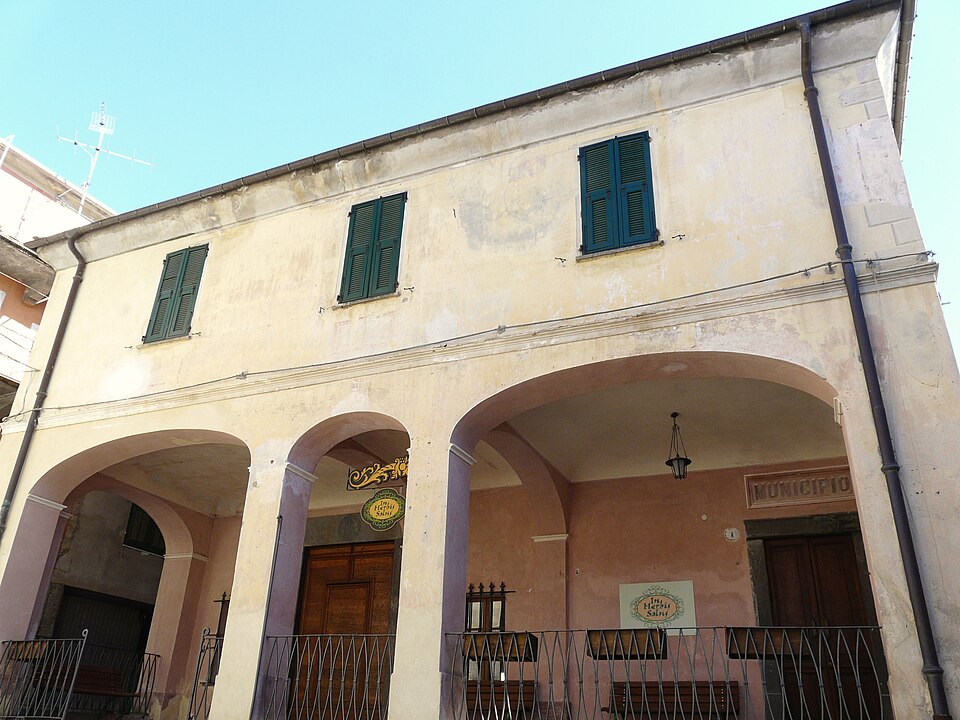
Beside the Oratorio dell’Assunta, three arches across the front identify the former town hall. A good way into its museum, In Herbis Salus, is to read a label twice. Each plant carries a Latin name and a common one. The collection includes edible, medicinal and aromatic species found in the valley. Equipment for making tinctures and a still for lavender pick up the story after the harvest. A flower that someone knew how to recognise on a hillside was also a raw material someone else knew how to process.
To visit both collections, contact the town hall on +39 0183 327803. The Ministry of Culture lists summer opening for the herb museum and visits by arrangement or during events for the rest of the year. Arrange access to the Spazio Simondo in advance. The lanes, the old town hall portico and the outside of the oratory make a short walk of their own. For 30 August 2026 the regional heritage office planned a route linking Cosio with Montegrosso, where local guides introduced the mountain households’ cucina bianca, and with the mill and shepherd’s house at Mendatica. A lavender still here and a millstone there make a good pairing on any visit. Both show how much work lay between gathering something and putting it to use.
Maps and sources
- Letizia Goretti, the Cosio meeting, chapter 1.7, printed pp. 50–53
- Fondazione CRC and Archivio Simondo, the Alba retrospective
- Cosio council on the collection in the old town hall
- Ministry of Culture, herb museum and visiting arrangements
- Map of the Spazio Piero Simondo
- Alpi Liguri park, stage 8 from Mendatica
- Regional heritage office, itinerary for 30 August 2026
Elsewhere in the guide · Madonna dei Colombi · Montegrosso Pian Latte
Photographs and credits
-
The former town hall in Cosio, now home to In Herbis Salus. Davide Papalini, 6 March 2010. Original photograph · CC BY-SA 3.0. Resized to 960 pixels wide.
-
Cover · Paper-cut interpretation of the July 1957 gathering in Cosio, inspired by Pinot Gallizio’s diary and the recollections collected by Letizia Goretti. ImageGen, mendatica.com.
