Montegrosso Pian Latte and the nights of the chestnut harvest
A small stone building in Via IV Novembre once kept the families of Montegrosso Pian Latte up at night. It is u canissu, the chestnut drying house. By the time the autumn fire was lit downstairs, the nuts were spread out overhead. Someone had to come back through the night. The village council remembers the sociable side of the vigil too. Relatives and neighbours brought out wine, roasted chestnuts, told local stories and went home with the smoke in their clothes. Its account, updated in 2024, names a farmer who still used the restored building for her crop, Donatella Sciandini.
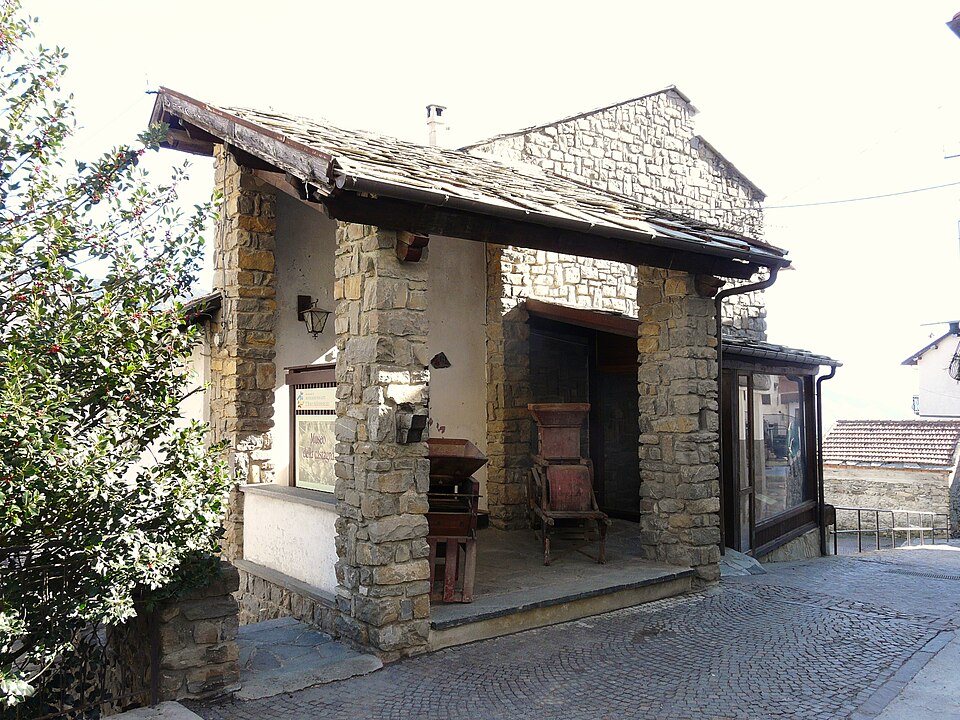
A good place to pick up the story is the old primary school at 19 Piazza Sagrato, beside the parish church of San Biagio. The chestnut museum occupies the ground floor. Under a shelter outside stands a machine built in the 1940s for beating the nuts. You are looking at the end of the process. Once dry, the nuts were beaten to free the kernels from their coverings. To understand how a chestnut ever got dry enough for that, walk back through the village to the drying house.
The fire below the crop
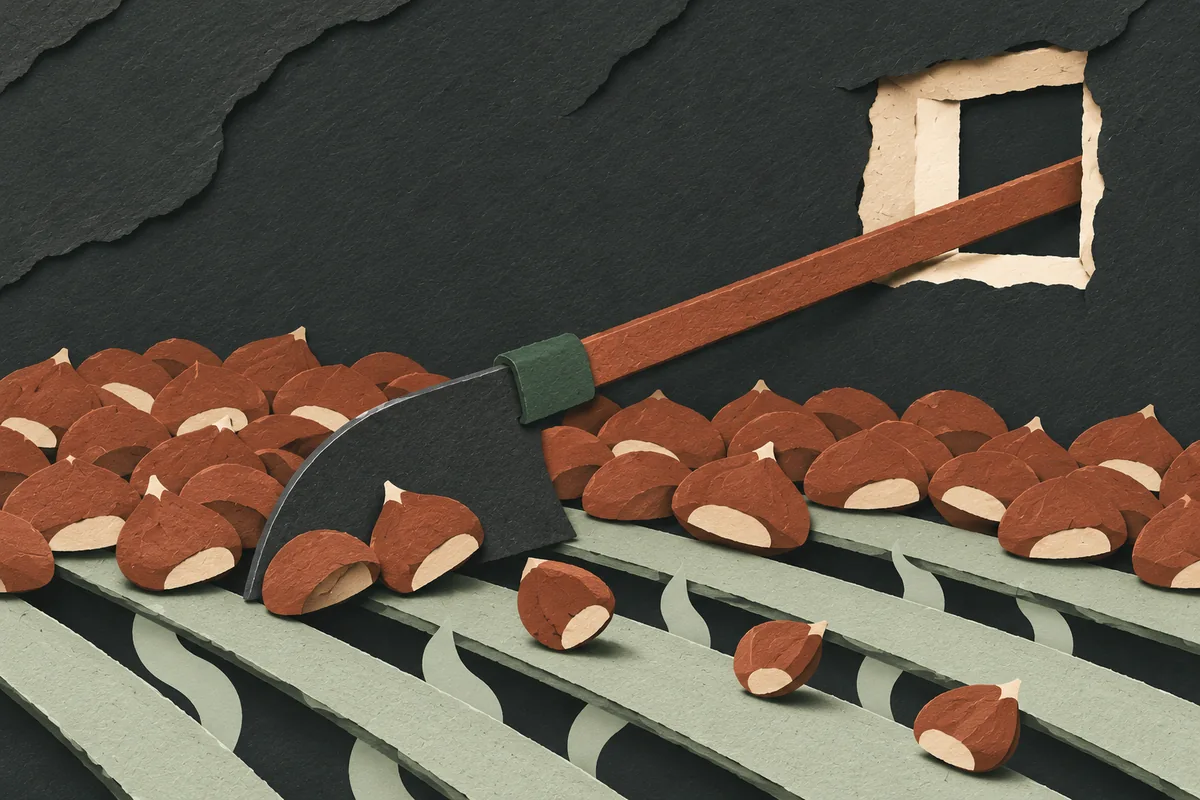
Canissu was also the name of the slatted floor that held the chestnuts. Smoke rose from a slow fire, through the gaps and up through the crop. Openings in the sides let someone outside reach in with a hoe-like tool and turn the nuts. The park’s account describes a fire kept going for about twenty days. The condition of the kernels determined when the job was done. The result was castagne bianche, the pale, peeled chestnuts that could feed a household long after the harvest.
From the drying house the interpretation trail continues towards the Bosco Addomesticato, the woodland shaped by the people who worked it. In a clearing there are two reconstructed charcoal stacks, one whole and one cut away to reveal the inside. They make sense after the drying house. In the village a deliberately open floor let the smoke rise through the nuts. In the woods the burners had to control the air that reached the wood beneath a covering of earth to turn it into charcoal. The trail finishes among the chestnut trees.
When the address said Mendatica–Montegrosso
Back in the square, look for San Biagio. The council cites a deed from 1465 recording that the earlier church answered to Mendatica. Centuries later the neighbouring village’s name would appear on civil records too. Archivist Iolanda Bovani traced the changes. Montegrosso belonged to Cosio from 1923 to 1925. In 1928 it became part of the joint municipality of Mendatica–Montegrosso, an arrangement that lasted until it regained independence in 1950. Today it is Montegrosso’s own town hall that arranges admission to the old school. Call +39 0183 328731 on a weekday, Monday to Friday.
The museum room, the machine in its outdoor shelter and the working drying house have separate visiting arrangements. The council lists the interior of the canissu in Via IV Novembre as closed to the public. You can see the building from the lane, read the panels and continue to the charcoal clearing. The shepherd’s house at Mendatica makes a fitting next stop. After learning how many nights went into preserving a chestnut, it is worth looking closely at the tools that mountain households used to process their milk.
Maps and sources
- Montegrosso council, the drying house in Via IV Novembre
- Montegrosso council, chestnut museum
- Alpi Liguri park, woodland trail and museum access
- Montegrosso council, San Biagio and the 1465 deed
- Iolanda Bovani, SIUSA archival authority record
- Map of the museum
Elsewhere in the guide · Mendatica village · Cosio d’Arroscia
Photographs and credits
-
Outdoor display at the chestnut museum in Montegrosso Pian Latte. Davide Papalini, 6 March 2010. Original photograph · CC BY-SA 3.0. Resized to 960 pixels wide.
-
Cover · Paper-cut interpretation of work in the canissu, based on Montegrosso’s local account and the Alpi Liguri park’s description. ImageGen, mendatica.com.
