Rezzo and the upper Arroscia valley, a wood in a basketmaker’s hands

A statue in Rezzo shows a man weaving a basket. To understand what he is holding, come down in your mind’s eye a few hundred metres from the tall beeches near the Passo della Teglia. Lower in the Giara valley grows hazel. Its branches yielded scuje, strips of wood supple enough to weave into a cavagno. Baskets like these carried olives, chestnuts, vegetables and mushrooms. The harvests of very different slopes all fitted into something light enough to pick up by its handle.
Rezzo stands in the side valley named for the Giara stream, about ten kilometres from Pieve di Teco. In July 2023 Gianfranco Sciandini of Mendatica showed his cavagni at the Arti & Sapori fair in Pieve. The same report records Nadia Albavera of Cenova, a hamlet of Rezzo. She had taught herself to carve slate by studying the old stonemasons’ work in its lanes. At Pieve, carved stone from the Giara valley and baskets from the upper Arroscia shared a market.
Letters about the beechwood
On 12 May 1863 a lawyer named Carlo Diana wrote from Aurigo to the mayor and councillors of Rezzo. While convalescing the previous autumn he had written an account of the municipal beechwood. He set down the fellings, decisions and disputes that preceded its sale on 16 June 1862. He had worked on the case himself. Someone dealing with the purchasing company in the future, he suggested, might need to know how it all came about. That June the mayor, Orengo, wrote back. The council had ordered the account to be printed. It appeared in Oneglia in 1864.
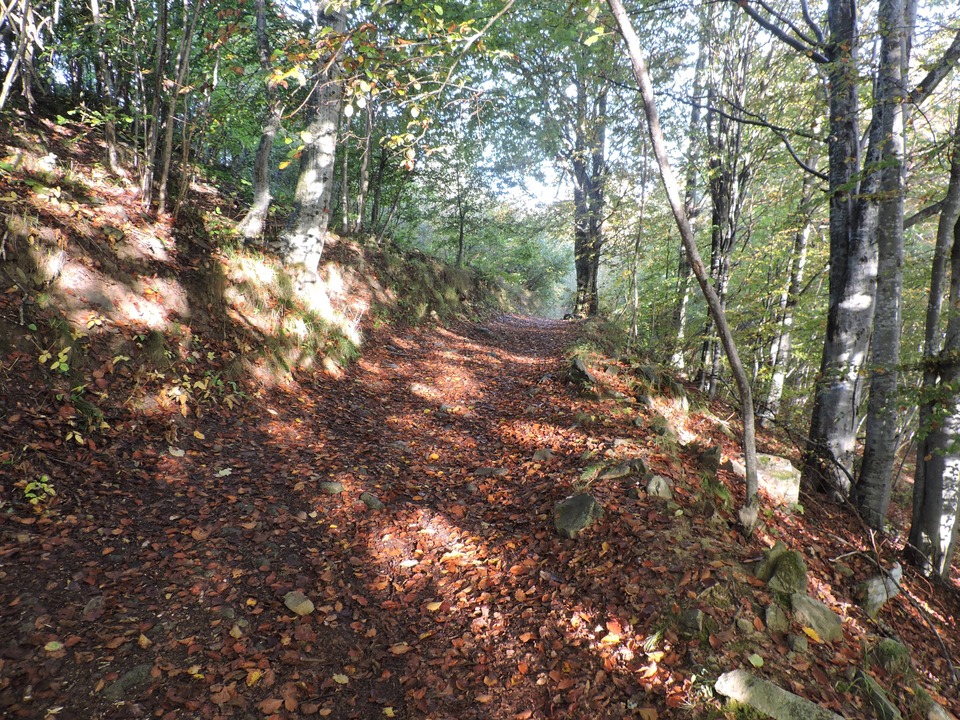
In the beechwood, between 900 and 1,400 metres, one of the best clues to how people used the forest is a patch of empty ground. The park describes level clearings where charcoal burners and lime makers worked into the first half of the twentieth century. Lower down, the trail descending from Passo Pian Latte passes hornbeam, oak and hazel before reaching the bridge over the Giara. Here the basket material falls into place in the landscape. To see how a charcoal stack was built, look for the two reconstructions on the chestnut museum trail in Montegrosso Pian Latte.
Walking from the village to the sanctuary
A walk that starts in Rezzo itself begins in the town hall square. Follow the old mule track past the Stations of the Cross to the sanctuary of Nostra Signora del Santo Sepolcro e di Maria Bambina. The heads of the village households agreed to build it in 1444. It was consecrated in 1492. One piece of stonework is visible before you even go in. The rose window was carved from a single block. Inside, on one wall, an anonymous painter from the French tradition depicted the Last Judgement, while Pietro Guido da Ranzo painted scenes from the life of Christ. Ask the parish of San Martino in Rezzo about opening before setting out. The churchyard makes a destination in its own right on the walk up from the village.
The upper beechwood is a separate outing. The SP17 traverses it on the way to the Passo della Teglia. As of 23 November 2026, the winter closure to vehicles, in force from 9 November until further notice, covers the stretch from kilometre 7.050 above Rezzo to kilometre 29.300 above Andagna. For a visit this season, choose the village and the mule track to the sanctuary. Check for a provincial reopening notice before planning to drive across the pass. The walking route from Passo Pian Latte to Rezzo is a substantial trip in its own right. The park gives 16 kilometres, with a slippery section fitted with aids on the final climb to the village.
Maps and sources
- Riviera dei Fiori, basketmaking in Rezzo
- Trucioli on Nadia Albavera of Cenova and Gianfranco Sciandini of Mendatica
- Carlo Diana, Memoria storica, p. [3], letter to the council
- Carlo Diana, p. [4], Aurigo, 12 May 1863
- Mayor Orengo, p. [5], the council’s reply
- Alpi Liguri park, the Rezzo beechwood
- Alpi Liguri park, stage from Passo Pian Latte
- Turismo Rezzo, the Stations of the Cross mule track
- Turismo Rezzo, the Holy Sepulchre sanctuary
- Albenga-Imperia diocese, parish of San Martino
- Map of the sanctuary west of Rezzo
- Province of Imperia, winter SP17 closure, notice 32411/2026
Elsewhere in the guide · Charcoal stacks at Montegrosso · Pieve di Teco
Photographs and credits
-
The Rezzo beechwood near the Passo della Teglia in autumn. Pampuco, 17 October 2017. Original photograph · CC BY-SA 4.0. Resized to 960 pixels wide and converted from PNG to JPEG.
-
Cover · Paper-cut interpretation of the Rezzo valley craft of weaving a cavagno with flat hazel strips called scuje. ImageGen, mendatica.com.
